


7 Marlow, Buckinghamshire: A Literary Place Part 2
TS Eliot
In the second of our two articles focusing on Marlow’s literary alumni, we look at the life and works of TS Eliot, who moved to Marlow with his new wife while teaching at High Wycombe’s Royal Grammar School.
TS Eliot 1888-1865
TS Eliot’s ‘The Waste Land’, bewildered and shocked in 1922 but radicalised poetry. It’s famous opening line ‘April is the cruellest month’ startled almost as much as that of his earlier poem ‘The Love Song of J Alfred Prufrock’ where he describes the sky as ‘like a patient etherised upon a table.’ Identified as a representation of the disintegration of society after WW1, Eliot’s later comments suggested it was as much about the disintegration of his marriage, but ‘The Waste Land’ stands as a giant in modern literature, offering a bewildering series of perspectives.
After the initial shock and scandal, by 1948 Eliot was awarded the Nobel Prize in Literature ‘for his outstanding, pioneer contribution to present-day poetry’.
The pioneering poet, Thomas Stearns Eliot, was born in 1888 in St Louis, Missouri to a wealthy intellectual family. Physically frail, he read hugely and started writing poetry at 14. After a PhD at Harvard, he studied philosophy at the Sorbonne from 1910-11, encountering the – for him – profoundly influential symbolist movement. After further studies in Indian philosophy and Sanskrit, Eliot left America in 1914 to study in Germany but the outbreak of War led to him taking up a scholarship at Merton College, Oxford.
1915 was a significant year. Disenchanted with Oxford, Eliot moved to London, met Vivienne Haigh-Wood and married her two months later. This despite having just declared his love for a long-time friend in America, Emily Hale.
Eliot took various teaching jobs, including one term at The Royal Grammar School High Wycombe, which brought him to Marlow with his wife. He also wrote ‘The Love Song of J Alfred Prufrock’, which Ezra Pound saw published bringing Eliot to the attention of the literary world, with responded with shock.
 The Marlow House
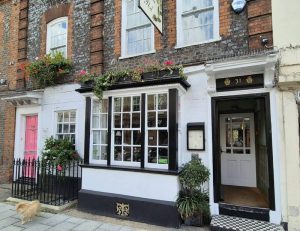
Eliot and Vivienne lived in Marlow at 31 West Street. The three-storey terraced property known as the Old Post Office, had been one of several in Marlow. Although its age is unclear, its façade is similar to several close by that were re-fronted in a classical style in the 18th century. There are decorative vertical red brick columns and paler brick around the arched windows. The building now sports a plaque identifying it as TS Eliot’s home. During his time there, he wrote ‘Gerontion’ and early sections of ‘The Waste Land’. The building is now part of The Vanilla Pod, a bijou restaurant with an excellent menu.
After one term teaching French, Latin, maths, drawing, swimming, geography and history, Eliot took a post at Highgate Junior School. In addition, he taught a three-year university-level course for Birkbeck College London which was accessible to adults of all social classes. In 1919 he accepted a position in the Colonial and Foreign department of Lloyds Bank. To his fluent French and German, he added a working knowledge of Spanish, Portuguese, Danish, Swedish and Norwegian.
In 1925 Eliot took up a position at publisher Faber and Faber, staying there for 40 years and publishing the work of many great 20th century poets and writers. His reputation as intellectual was sealed by his poetry, literary criticism, and plays.
Sadly, Vivienne’s poor health quickly took a toll on their marriage. Her physical and mental decline led to their separation in 1933. She died in a home in 1947. For nearly 20 years, his public companion was Mary Trevelyan, of London University. At 68, Eliot married his 30-year-old secretary of some 8 years.
Eliot took British citizenship in 1927. His lighter poems about cats were posthumously transformed by Andrew Lloyd-Webber into the multi-award-winning musical ‘Cats’ in 1981.
Key works
 Poetry: ‘Prufrock’, ‘The Waste Land’ 1922, ‘Ash Wednesday’ 1930, ‘The Four Quartets’ 1936-42, ‘Old Possum’s Book of Practical Cats’ 1939
Plays (written in verse): ‘Murder in the Cathedral’ 1935, ‘The Family Reunion’ 1939, ‘The Cocktail Party’ 1949