6 Marlow, Buckinghamshire: A Literary Place Part 1.
Not a specific house this month, but two. The pretty Georgian town of Marlow, sited on the Thames, has been – and continues to be – home to a number of literary figures.
These included Percy and Mary Shelley (and their friend Thomas Love Peacock), Victorian novelists Jerome K Jerome and GPR James, genre-shattering poet TS Eliot – and children’s writer, Enid Blyton. In the first of two articles this month, we explore the lives of a remarkable early 19th couple. Although this month’s literary figures only lived briefly in Marlow, it is not an exaggeration to claim that the works they wrote there not only changed Western Literature, but also changed the world.
Marlow
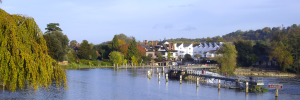
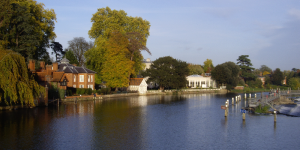 A Georgian market town full of listed buildings and sitting beside the River Thames, Marlow is considered one of the ‘coolest’ places in Britain to live. The elegant suspension bridge which spans the town and links Buckinghamshire to the north with Berkshire to its south, was designed by William Tierney Clark and opened in 1832. The Thames brought Marlow goods and prosperity and a raft of wealthy and famous residents. Today, the streets are vibrant with independent shops and eateries, perhaps the most
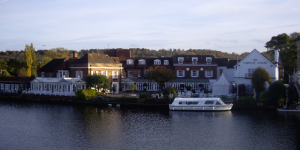 famous of which is four-star The Compleat Angler, (its name taken by a 1656 book on fishing by Izaak Walton) sited by the weir and offering Michelin-star dining as part of the Macdonald Hotel Group.
The Shelleys
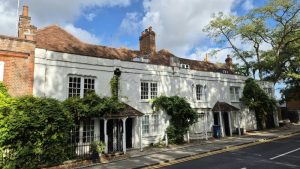 It is hard to imagine a place less likely to conjure images of sentient monsters assembled from body parts of random criminals, but it was in Marlow that Mary Shelley finished the gothic story she created one soggy night in Switzerland. While her poet husband was writing about skylarks, Mary finished writing ‘Frankenstein’. Convenient for London, and on the up, Marlow was a safe distance from Percy’s disapproving and aristocratic family.
Mary Wollstonecraft Shelley 1797-1851
Mary was born into a free-thinking family. Her father was the political philosopher William Godwin and her mother – who died when Mary was 11 days old – was Mary Wollstonecraft, author of ‘A Vindication of the Rights of Women’. She was given an unorthodox and extensive education by her father, who described her at 15 as ‘singularly bold, somewhat imperious, and active of mind. Her desire of knowledge is great, and her perseverance in everything she undertakes almost invincible.’
At 16, Mary and the 21-year-old Percy Bysshe Shelley fell in love, trysting at her mother’s grave. He was a follower of her father’s political ideals, despite his aristocratic birth. Although he was married, in 1814 they eloped on a journey into Europe from which Mary returned pregnant. Sadly, the baby died but after two years of social ostracism and debt, Shelley’s wife’s suicide enabled them to marry in 1816.
That rainy summer, the Shelleys travelled to Switzerland and stayed with Lord Byron. It was trapped in that villa by poor weather that the group read German fairy tales and Byron challenged them each to write one. After initial block, Mary’s extensive reading about the latest developments in science, and Galvanism in particular, gave her the vision that was to become her first novel.
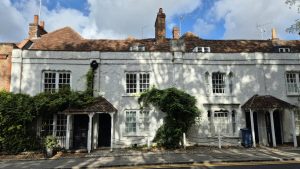
In 1817, the Marlow connection begins. The Shelleys were back in England and settled into Albion House on West Street where Mary finished ‘Frankenstein, or the Modern Prometheus’. The house, at that time large and damp, has now been divided into several properties, one named ‘Shelley Cottage’. The product of a teenager, ‘Frankenstein’ proved to be the original Gothic science fiction story, a best seller that has been endlessly debated and dramatised. The first stage version opened in 1823.
In January 1818 the book was published, anonymously as was common at that time for books written by women. Later that year the Shelleys travelled to Italy and, tragically having lost two more children (and bearing one more who survived), Mary lost her husband when he was accidentally drowned in 1822.
Mary returned to England, negotiated with her father-in-law for an allowance to raise his grandson and heir, and lived at first with her family until she could afford to move out. That brilliant mind supported her in supporting her child through her writing, but her unorthodox views and political persuasion and a marriage and friends tainted with scandal meant she was never central to society.
Percy Bysshe Shelley 1792-1822
Son of a Sussex-based baronet and Whig MP, Shelley was bullied at Eton, for his radical socialist views, and Oxford, from which he was sent down for writing a pamphlet attacking Christianity. At 19 he eloped with 16-year-old Harriet Westbook with whom he had two children. At 21 he eloped again with Mary Godwin. After extensive European travels, his first wife’s suicide enabled them to marry, although his family rejected them, causing financial hardship. Marlow provided them with a base close to London where they could both focus on writing.
Shelley’s radical views and expressive exploration of them through his poetry have led to his reputation as a leading figure in the Romantic movement, along with his friend Byron. The emotions within his poems soar from the tragic to the sublime and his further travels in Europe and Italy with Mary provided the best of times but also the worst of times in terms of human love, thought and loss. Key works include ‘Ode to a Skylark’, ‘Ozymandias’ (familiar to most GCSE Eng Lit students), ‘The Revolt of Islam’ (exploring war and religion), and ‘Prometheus Unbound’.
Shelley and Mary both supported open marriage but while Shelley had a number of affairs, it seems that Mary’s love prevented her from doing likewise, (she was also pregnant at least five times in the six years they were together).
Shelley’s tragic death crystallised his position as a key Romantic figure alongside Keats, Byron and Wordsworth.
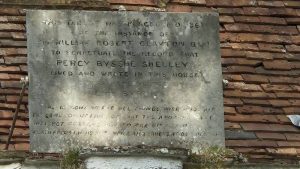
Ironically, given that most people have heard of ‘Frankenstein’ but have not read her husband’s poems, the plaque put up on the house in Albion Street in 1867 records for perpetuity that ‘Percy Bysshe Shelley lived and wrote in this house and was here visited by Lord Byron. There appears to be no mention of Mary!