

 Time to Shut Up: Should UK New-Builds include Shutters?
With record-breaking temperatures in the UK, and next year predicted to be even hotter courtesy of El Nino, is it time for UK housing developments to include shutters as a compulsory part of their design?
Under its sustainability regulations, the Future Homes Standards (FHS) makes low-carbon heating systems, enhanced insulation, better air tightness, advanced windows, and solar panels all mandatory, along with EV charging infrastructure. So why not add shutters as a practical solution to ventilation in hot weather?
Shutters are a practical addition to a property. In times of heat, they allow air to circulate while maintaining security. They can also be very decorative.
What are shutters?
Shutters can take several forms.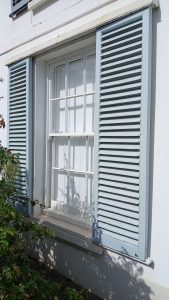
Internally, shutters in period houses are traditionally made of wood and run the full height and width of each window, folding on hinges or concertina-like into recesses in window embrasures. There, they blend in with the pannelling, whether polished or painted. They can be opened out to meet in the middle of the window, with a latch for security, or can be left partly open to allow some light and / or air into the room.
Externally, shutters would fulfil the same function, either folding on hinges to cover the entire window or sliding across it on tracks, as in the image. Traditionally made of wood, the shutters could be solid panels or constructed with angled slats or ‘louvres’.
Contemporary shutters, whether internal or external, may be made of a variety of materials and can cover all or part of a window. Internally, a system of rods or pulleys adjusts the angle of any louvres to control air flow and light ingress.
Electronic controls may also be installed now to adjust these, indoors and out, and shutters can be customised to suit budget and style.
Construction
Historically, shutters were made of wood, painted or plain. The outer frame could either be filled in with solid wooden panels, decoratively fielded, or solid wooden slats, polished or painted. Alternatively, the frame could be filled with horizontal louvered slats (as above).
Today, shutters can be made of numerous other materials depending on function, location and style of property.
- Steel shutters provide strength and security along with urban chic/functionality.
- Wood is attractive and easy to paint to accessorise or custom decorate, but does require repainting and maintenance. Some woods are obviously more durable than other, for example, Spanish cedar and Honduran mahogany and teak. They have the added advantage of deterring insects because of the tannins in the wood. Pine is cheap but needs replacing more frequently because of its softness, although the tannelising process does provide some additional durability.
- PVC is a popular modern choice. It does need more hardware than wooden shutters and should be painted with vinyl-safe paint to prevent bowing in the sun’s heat. Aluminium has also become popular, being lightweight.
Outside the UK
Shutters are a feature of properties across the world. From Africa to Australia, the Caribbean to America’s Deep South and across to the blue Mediterranean, shutters provide protection from light, wind, rain, snow, debris and the intrusion of wildlife. They also provide protection from the intrusion (physical or ocular) of strangers.
Seen on holiday, picturesque shutters enhance to the ‘foreignness’ of our travel. Whether adding architectural rhythm in chic steel on the facades of Parisian town houses or the charm of colourful paintwork on Greek cottages, these vernacular variations combine practicality with decoration.
As our annual temperatures climb, isn’t it time the UK also ‘shuttered-up’?