

Are Solar Farms Becoming a Risk for Rural Communities?
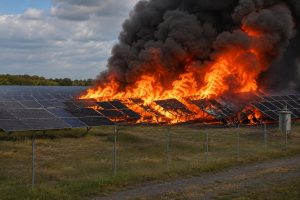
Solar farms have become an increasingly common feature of the British countryside. Driven by the need for renewable energy and the Government’s commitment to reducing carbon emissions, large-scale solar developments are now appearing across many parts of England, Scotland and Wales.
Supporters point to their environmental benefits, contribution to energy security and potential to reduce dependence on fossil fuels. However, as the number and size of solar installations continue to increase, questions are also being asked about the potential risks associated with these developments.
Whilst much of the public debate focuses on visual impact and the loss of agricultural land, other concerns are beginning to emerge, including fire safety, security, infrastructure resilience and the potential implications for nearby property owners.
Fire Safety Concerns
One issue that has attracted increasing attention is the risk of fire associated with solar energy installations and battery storage facilities.
It is important to distinguish between traditional solar panel arrays and the large battery energy storage systems (BESS) that are increasingly being developed alongside them. Solar panels themselves are generally regarded as presenting a relatively low fire risk when correctly designed, installed and maintained.
However, battery storage facilities introduce a different set of challenges.
Recent incidents in both the UK and overseas have highlighted the difficulties associated with fires involving large lithium-ion battery installations. Once thermal runaway occurs within a battery system, fires can be extremely difficult to extinguish and may continue for extended periods.
In March 2025, a significant fire occurred at the Cirencester Hybrid Solar Farm in Gloucestershire. Emergency services dealt with a blaze involving battery storage containers, raising questions regarding the management of large-scale battery installations and their proximity to surrounding communities.
Although incidents remain relatively uncommon, the consequences can be substantial when they occur.
Security and Vandalism
Another issue receiving less attention is site security.
Many solar farms cover large areas of land, often in relatively isolated rural locations. This can make them vulnerable to theft, criminal damage and vandalism.
Incidents have been reported overseas where extensive damage was caused to solar infrastructure by trespassers. While such events remain rare, they highlight the potential vulnerability of large installations and the need for effective perimeter security, monitoring and maintenance.
For landowners hosting solar farms, security arrangements should form an important part of any lease or development agreement.
Impact on Agricultural Land
The use of agricultural land for solar energy generation remains a contentious topic.
Supporters argue that solar farms can provide farmers with a stable income stream and that some sites can continue to support grazing or biodiversity initiatives.
Critics, however, point to the cumulative loss of productive farmland and the concentration of large developments in certain rural areas.
The debate is likely to intensify as developers seek increasingly larger sites to meet future energy demands.
From a property perspective, buyers considering rural homes may wish to investigate existing or proposed solar developments in the surrounding area, particularly where significant expansion is planned.
Infrastructure and Grid Dependence
Large-scale solar developments often require associated infrastructure including substations, transformers, cabling and battery storage facilities.
Whilst much attention is paid to the panels themselves, these supporting elements can have a significant impact on the local environment and landscape.
Battery storage systems, in particular, introduce additional complexity. As the UK’s electricity grid becomes increasingly dependent on intermittent renewable generation, the role of large-scale battery storage is expected to expand considerably.
This may result in more battery facilities being proposed in proximity to residential areas, creating new planning and risk assessment challenges for local authorities.
Property and Planning Considerations
For homeowners, the most immediate concern is often not safety but the effect that nearby developments may have on property enjoyment and future resale prospects.
Views differ on whether solar farms have a measurable impact on residential property values. In some locations there may be little or no effect, particularly where sites are well screened and located some distance from housing.
However, where developments involve extensive battery storage infrastructure, increased traffic, substations or significant visual change, prospective purchasers may take a different view.
Anyone purchasing property in a rural area should consider reviewing local planning applications and development plans to identify any proposed energy infrastructure projects.
As with other forms of development, understanding what may be built nearby can be just as important as assessing the property itself.
A Balanced View
Solar energy is likely to play an important role in the UK’s future energy mix, and many solar farms operate without incident.
Nevertheless, as developments become larger and increasingly incorporate battery storage technology, it is reasonable for local communities and property owners to ask questions regarding safety, security, land use and long-term environmental impact.
The challenge for developers, regulators and planning authorities will be to ensure that renewable energy objectives are balanced with appropriate safeguards for neighbouring residents and the wider countryside.
As with any significant infrastructure project, careful planning, transparent consultation and robust risk management remain essential.