

National Trust reports £5.1 million Scone Income, and other positives!
Young people are not just curl up with tea and a book – they are keeping the NT going by visiting the house of the author that wrote it and eating scones!
In a new regular feature, we look – as it says on the tin – at National Trust properties with literary connections. The National Trust, national treasure, allows us to combine the pleasure of exploring the homes that gave sanctuary and inspiration to some of the nation’s greatest writers, with the probability of reliably good coffee and cake. What greater joy can life offer, especially when the world currently seems a very scary place?
I do not jest. 25.9 million people did just that in 2024-5, and the National Trust’s annual report for 2025 confirmed that scones provided £5.1million of its income. The visitor numbers increased just enough to enable the Trust to meet its target for growth of 25.8 million.
The National Trust today
The National Trust’s annual report for 2025 also showed a total income of £766.2 million, with £321million of that directly coming from property and £309.4 million in membership fees.
The number of members fell slightly by 0.4%, but 403,000 new members joined and 83.3% of existing members renewed their membership. Paying visitor numbers increased by 5%. This would appear to reflect the cost-of-living crisis as young families, in particular, are having to be more selective about how they use their resources and so are choosing to ‘pay as they go’ rather than commit to membership up front.
Those membership costs have gone up by 5.6%, but with maintenance costs surging at least 4% above annual inflation, the Trust has a delicate balancing act to manage. Sadly, with the current world political situation and soaring prices of raw materials, their costs are likely to be even higher in 2025-6.
A positive that emerged was the surge of young people taking out National Trust membership for 18 to 25-year-olds. Over 40,000 signed up, a 39% increase on the previous financial year, with a further 16% increase between March and July 2025.
It is thought that the benefit to well-being of spending time in natural and beautiful environments is particularly valued by the young. Research carried out by the National Trust with the consultancy firm Public First, found that across the UK, people are deeply connected to our historic landmarks.
Perhaps more surprising is that the research findings suggested that the 18-44 demographic is more likely to visit sites of cultural, heritage or interest to do with landscape than older generations. This research is backed up by parallel investigations by the Historic Houses Association.
So, today, here is a brief look at Hughenden Manor near High Wycombe in Buckinghamshire. This was the home of Victorian Prime Minister and novelist, Benjamin Disraeli, originator of many pithy lines including “When I want to read a novel, I write one”, and “There are three types of lies — lies, damn lies, and statistics.” He wrote novels, poems, plays, drama and non-fiction. The best-known of his novels are probably ‘Sybil’, ‘Coningsby’ and ‘Vivian Grey’.
Hughenden Manor
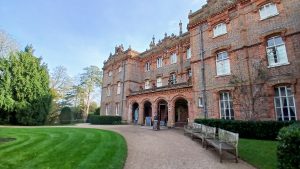
The house is set in a beautiful valley with a serpentine stream on the valley floor and 1500 acres of native woodland to explore. Close to the house are the more formal gardens with an Italianate parterre, statues and a productive walled garden. The house itself is a Victorian construction of red brick in a ‘Jacobethan’ style, remodelled in 1862 by Edward Buckton Lamb, but with a history that reaches back to 1086. It was purchased in 1847 by Disraeli’s father, Isaac D’Israeli, with the help of a loan from Conservative Party dignitaries, to provide his son with a property suitable for his position as Leader of the Conservative Party. Victorian politics demanded that senior politicians be members of the landowning classes.
A Grade 1 Listed Building, the house is dignified as befits a Prime Minister, but not overwhelming. Pevsner described the unusual window pediments as ‘indescribable’ and Lamb’s work at Hughenden as ‘excruciating’, but Disraeli loved it. Lamb removed all Georgian classicism and replaced it with ‘drama’! The interior reflects Disraeli’s wide-ranging interests and political importance and the large Victorian plate glass windows allow plenty of light and views over the gardens.
World War Two
A chance remark by a visitor, overheard by a volunteer guide, revealed that Hughenden had secretly been used during WW2 for making the layered fabric maps used by the Air Force to navigate to targets in Europe. This triggered research and a section of the house has been given over to the findings in the form of a fascinating exhibition. This explores how the maps were made and the individual artists and illustrators who covertly lived in the house working on them.