6 John Masefield, Poet Laureate, and Ledbury, Herefordshire.
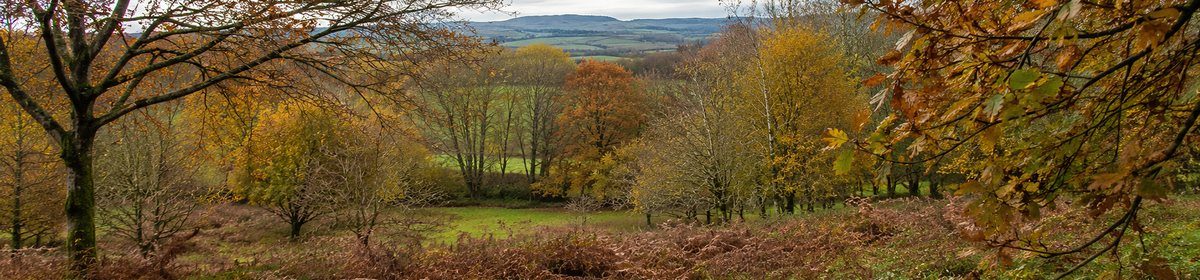
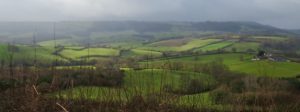
Best known for ‘Sea Fever’, Masefield grew up in Ledbury, where the swell and waves were of Herefordshire’s green hills, lush fields and many orchards.
 John Masefield was Poet Laureate from 1930 until 1967, the second-longest standing Poet Laureate after Tennyson. Born in Ledbury, and loved for his best-known poem ‘Sea Fever’, it is actually the streets, buildings, church and fields surrounding the glorious Herefordshire market town that framed his life and inspired some of his best work.
John Masefield 1878-1967
Masefield was born at The Knapp, a house at the northern end of Ledbury. He was the third of six children born to George Masefield, a solicitor in the family firm, and his wife Caroline. The young Masefield had an idyllic early childhood roaming the orchards woods and hills around Ledbury, however, his mother’s death when he was six was closely followed by that of his father. The children went to live at The Priory, beside the parish church, with his strict and unsympathetic aunt and uncle. John was sent away to Warwick School.
Escape: The Sea, America and Key Poems
At 13, Masefield joined HMS Conway, a training ship for the merchant navy. In 1884 a difficult passage round Cape Horn to Chile on the Gilcuix left him ill. He did return to the but left the ship at New York. There he spent two years living rough, working in a bar and then a Yonkers carpet factory. During this time he read incessantly and decided to make writing his career.
In 1897 he worked as a journalist in London and began publishing verse. It was in his 1892 first collection, ‘Salt Water Ballads’, that ‘Sea Fever’ appeared. The longing for a ‘tall ship’ and compelling rhythm of ‘I must go down to the seas again/To the lonely sea and the sky’ caught imaginations everywhere and made it one of the best-known poems in English. ‘Cargoes’ was also a popular early poem, contrasting the exotic foreign barks and lands like the ‘quinquireme of Ninevah’ with the ‘Dirty British coaster with salt caked smoke stack’.
In 1911 Masefield achieved his breakthrough with a long narrative poem about a drunken poacher, Saul Kane. Entitled ‘The Everlasting Mercy’, it is set in and around Ledbury and his use of rough and frank language shocked and thrilled his readers. The poem takes the reader through Ledbury’s Market Place, the Homend, the Scallenge by the church gates as well as Church Land and Cabbage Lane. This success was followed by a series of narrative poems:
- ‘The Widow in the Bye Street’ (1912), a tragedy named after Ledbury’s Bye Street, though the poem calls the town Shropshire
- ‘Dauber’ (1913), drawn from his own voyage round the Horn
- ‘The Daffodil Fields’ (1913)
- ‘Reynard the Fox’ (1919), a vivid picture of an English hunt
In addition, Masefield wrote novels, including children’s books ‘The Midnight Folk’ (1927) and ‘The Box of Delights’ (1935). Other poems that look back to his childhood in the Herefordshire Countryside include ‘On Eastnor Knoll’ and ‘The West Wind’.
Poet Laureate and Domestic Detail
Masefield’s happy 57-year marriage to Constance Crommelin began in 1903. They had two children. When WW1 intervened, he served with the Red Cross in France and on a hospital ship at Gallipoli, about which he wrote a prose account, ‘Gallipoli’ (1916).
In 1930 Masefield succeeded Robert Bridges as Poet Laureate. The same year Hereford gave him the freedom of the city, an honour last given to a non-resident when Nelson received it in 1802. He received the Order of Merit in 1935 and championed poetry read aloud.
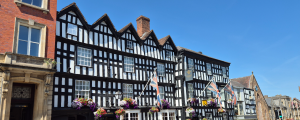
Ledbury and Masefield’s buildings
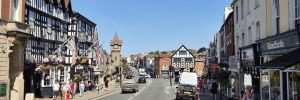
Ledbury is recorded in the Domesday book as ‘Liedeberge’. This name probably arises from combining the River Leadon (on which it stands) with ‘burg’, the Old English word for a fortified site. Sited in lush countryside to the west of the Malvern Hills, Ledbury became prosperous during Elizabethan times and contains many splendid timber-framed buildings. Poetess Elizabeth Barrett-Browning was also born in Ledbury and there is a fine memorial to her there. An annual poetry competition and festival – with an emphasis on poetry spoken aloud – bears testimony to the importance of Ledbury’s literary greats.
Several Ledbury buildings are bound up with Masefield’s story, and most can still be seen.
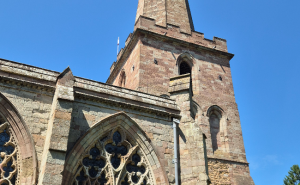
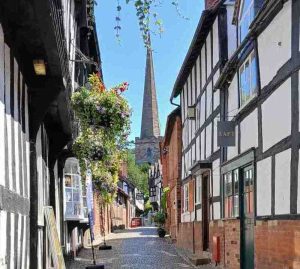
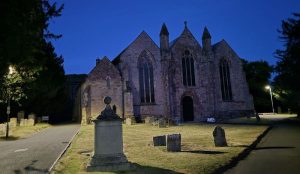 St Michael and All Angels. Pevsner called this the premier parish church of Herefordshire. It is Grade I listed. It was the church of Masefield’s boyhood; he recalled attending services there from about 1886. Its tall spire and golden weathercock appear in The Everlasting Mercy as “a golden vane surveying half the shire”. The original weathercock is on display inside the church. Cobbled Church Lane and the Scallenge outside the church gates both feature in Saul Kane’s wild run through the town.
The Priory, where he grew up after his parents’ deaths, stands between the churchyard and Worcester Road.
The Knapp. His birthplace on the Homend still stands, hidden behind tall trees. It is a private house and is not open to visitors.
Preston church. The church where he was baptised has a memorial plaque to him, presented by the Masefield Society in 1994.
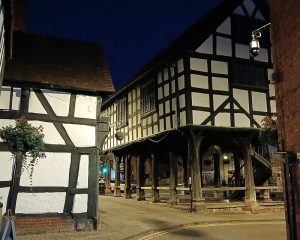 The Market House.
Ledbury’s timber-framed market hall of 1617 (right) is described in his poem “Wonderings”.
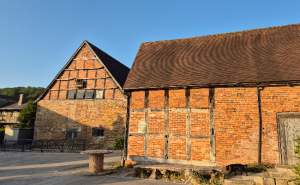 The Master’s House. This fifteenth-century building is now Ledbury’s library. It houses the archive of the John Masefield Society, along with an exhibition about him.
John Masefield High School. The town’s secondary school carries his name.
Westminster Abbey. Beyond Ledbury, his ashes lie in Poets’ Corner, where his stone reads simply “John Masefield O.M. 1878–1967 Poet Laureate”.
Masefield Memorial
The town is currently planning a permanent memorial for Masefield’s 150th anniversary in 2028 and Ledbury Town Council’s Masefield Matters project has won a £220,000 National Lottery grant.