
Houses with Literary Connections 6: Vita Sackville-West and Sissinghurst
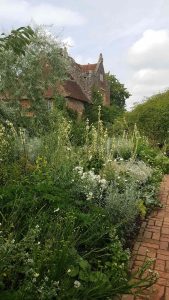
Sissinghurst is synonymous with white. Whether it is the famous white garden that has inspired gardeners of properties large and small across the world, or the addition of the name to flowers such as a white form of pulmonaria, Sissinghurst = white.
Vita Sackville-West’s unorthodox and tempestuous life and loves are well documented, perhaps better known now than her success as a prolific writer and journalist.
Vita Sackville-West 1892-1962
Vita was born Victoria Mary Sackville-West in 1892 at Knole in Kent, the only child of Lionel Sackville-West, 3rd Baron Sackville, and his cousin Victoria. Vita’s mother was the convent-raised, illegitimate daughter of the 2nd Baron Sackville and a Spanish dancer Petita (real name Josefa Duran y Ortega).
Knole, now itself a National Trust property, had been given to the Sackvilles by Elizabeth 1st. Through Salic law, female Vita was not able to inherit Knole when her father died, which was a life-long grief.
A lonely child, educated by governesses and later at an exclusive Mayfair girls’ school, Vita wrote prolifically, including in French, from an early age. She felt inferior intellectually to her peers in the Bloomsbury Group and particularly to her lover Virginia Woolf.
Vita the Adult
At 18, debutante Vita was courted by scions of noble and wealthy families, including the future Lords Harewood and Granby. After a marriage-busting affair with historian Geoffrey Scott, she rejected them all in favour of a (relatively) penniless diplomat, Harold Nicolson. They travelled widely and lived initially in Constantinople (now Istanbul), where Nicolson was posted until the birth of the first of their two children.
However, the Nicolson’s relationship was unorthodox. It was a lifelong affectionate partnership but it was an open marriage with both Vita and Harold having homosexual relationships throughout at a time when this was considered morally and socially unthinkable. This duality in Vita’s sexuality, together with her interest in a possible Roma exoticism through her grandmother, appears in the themes and character of her writing, including thinly veiled references to her lovers. These included (amongst others) Violet Keppel, whose mother Alice was Edward VII’s mistress, and Virginia Woolf. Woolf depicted Vita in her novel ‘Orlando’, in which the protagonist moves through history, changing gender at different points, to experience events from different perspectives.
Vita and Writing
Vita wrote copiously throughout her life. Even as a child she wrote novels and poems. Her lover Virginia Woolf commented on how ‘fluently’ she wrote and, at the time, Vita’s works received greater public acclaim than her own, more experimental, writing. In 1927, Vita won the Hawthornden Prize for her 1926 poem ‘The Land’, winning it again in 1933 (the only writer to do so twice). She also wrote a play, autobiographies (such as that of Restoration playwright Aphra Behn and of her grandmother, Pepita), travelogues and guides, including guides to Knole, Berkeley Castle and Hidcote Manor.
Vita and Sissinghurst
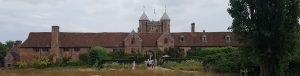
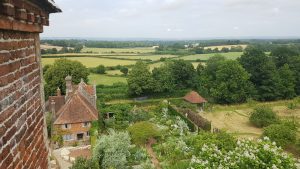
 In 1930, the Nicholsons moved to Sissinghurst Castle, which had once been owned by Vita’s Sackville ancestors. It was an Elizabethan ruin and the creation of a dwelling and surrounding gardens was a labour of love that lasted decades. Vita took up writing again, too, as with Harold retired from diplomacy and two boys at Eton, they needed money.
From 1946 until 1961, the year before her death, Vita wrote a column “In your Garden”, in The Observer. Although she was not a trained horticulturalist, it made Sissinghurst one of the most visited gardens in England and 1948 she became a founder member of the National Trust’s garden committee.
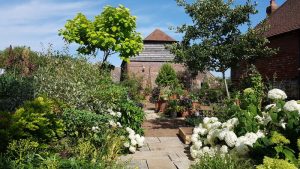
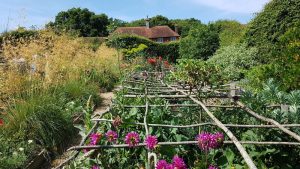 When Vita died in 1962 her son Nigel came to live at Sissinghurst. He was followed by his son Adam, whose wife Sarah Raven owns the nearby flower-growers’ paradise, Perch Hill Farm (photos left and below).
Vita Sackville-West Key Literary Works
The following list is extremely selective as she wrote extensively in most genres!
Poetry – more than a dozen collections, including the Hawthornden prize-winning ‘The Land’ in 1926 and ‘Collected Poems’ in 1933.
Novels – at least 13, some unpublished juvenilia
- Seducers in Ecuador(Hogarth Press, 1924)
- The Edwardians (1930)
- All Passion Spent (1931)
- No Signposts in the Sea(1961)
Plays
- Chatterton: a drama in three acts (1909)
Letters
- Portrait of a Marriage: Vita Sackville-West and Harold Nicolson by Nigel Nicolson
- Love Letters: Vita and Virginia by Virginia Woolf and Vita Sackville-West
Biographies
- Aphra Behn, the incomparable Astrea(Gerald Howe, 1927)
- Andrew Marvell(1929)
- Saint Joan of Arc (Doubleday 1936, reprinted M. Joseph 1969)
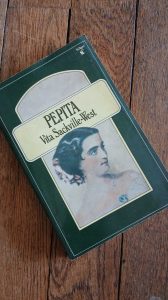
- Pepita (Doubleday, 1937, reprinted Hogarth Press 1970)
- The eagle and the dove, a Study in Contrasts: St. Teresa of Avila and St. Thérèse of Lisieux(M. Joseph, 1943)
- Daughter of France: the life of Anne Marie Louise d’Orléans, duchesse de Montpensier, 1627-1693, La Grande Mademoiselle(1959)
Guides
- Knole and the Sackvilles (1922) – a history of her ancestral home
- Twelve Days: an account of a journey across the Bakhtiari Mountains of South-western Persia (first published UK 1927; Doubleday Doran 1928; M. Haag 1987, reprinted Tauris Parke Paperbacks 2009 as Twelve Days in Persia)
- How does your garden grow? (1935) (Beverley Nichols, Compton Mackenzie, Marion Dudley Cran, Vita Sackville-West)
- Berkeley Castle (1960)
- Faces: profiles of dogs (Harvill Press, 1961, photographs by Laelia Goehr)
- Hidcote Manor Garden, Gloucestershire (1976)
Translations
- Duineser Elegien: Elegies from the Castle of Duino, translated from the German of Rainer Maria Rilke by V. and Edward Sackville-West (1931)
Journalism
- 1946-1961 she wrote a practical and popular Weekly garden column in ‘The Observer’