
5 Rewilding: How long does it take Nature to Fight Back? Part 1
A couple of weeks of damp weather and the lawns are greening up nicely in the UK. It led us to wonder how long it would take for nature and her wild habitats to recover from development?
Obviously, a lot depends on the type of landscape under discussion and the level of degradation. The most important variables are:
- how severely is the land degraded?
- What surrounds it (seed sources, wildlife corridors)?
- Is the soil structure and chemistry intact?
- Are the right conditions — hydrology, grazing pressure, absence of pollution — restored?
Over the next two issues, we investigate how long it takes nature to recover. We are focusing on UK-based research and evidence, appropriately, from the field.
We do not cover land that has been seriously damaged by industrial use or any major chemical contamination.
In order, we consider:
- Arable and (lowland)
- farmland
- Heathland
- Peatlands
- Woodlands
Next month we will look at:
- Grassland
- Brownfield sites
- Coastal and marine environments
1 Arable and (lowland) Farmland
A landmark study, the Monks Wood Wilderness Experiment, was started in 1961 when a barley field was ploughed and then left.
- Within 1–5 years: Ruderal plants such as thistles, nettles
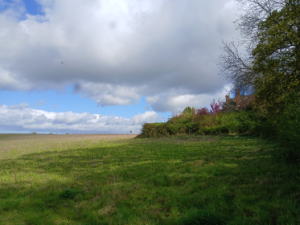 and docks, and annual grasses colonised first. These were quickly followed by bramble and scrub elder.
 - 10–15 years: A shrubland of thorn thickets emerged. Blackthorn and hawthorn dominated; the land looks wild but the ecology was not complex.
- 23 years: after 23 years, woody vegetation had become strong with 86% cover, the vegetation averaging 2.9 metres tall.
- 50–60 years: after 53 years, the Old Wilderness site had 100% woody cover averaging 13.1 metres tall, with a tree-canopy covering 91%. By this stage its structural characteristics were approaching those of neighbouring ancient woodlands.
Caveat: it has been shown that proximity to a seed source is hugely important. Fields adjacent to ancient woodland regenerate far faster and with much greater species diversity than isolated fields surrounded only by other farmland.
2 Heathland
Heathland was once widespread across lowland Britain, as witnessed by the word’s appearance in many place names, such as Hampstead Heath, Haywards Heath etc. The impact of intensive farming has reduced this.
Sadly, heathland is one of the most difficult habitats to restore because heather and other characteristic plants require acidic, low-nutrient soils.
An experiment on former grassland in Dorset found that after 17 years the pH of the unamended agricultural soil remained significantly higher than that of adjacent heathland. Natural colonisation by heathland species was slow due to seed limitation. Consequently, an acid grassland rather than heathland formed.
- With active restoration, heathland plant communities can begin establishing within 5–10 years, but true ecological maturity takes 30–50 years or more.
- Without active intervention in the form of soil stripping, heathland turf translocation, or seed application from nearby intact heathland, the soil chemistry simply cannot return unaided. It appears that, even over decades, a former arable field may never recover to true heathland.
3 Peatland (upland blanket bog, lowland fen and raised bog)
As gardeners know, we are desperate to preserve our peatlands and urged to buy peat-free compost. Peatlands have the slowest and most complex recovery of all UK land types.
The sad fact is that currently, approximately 80% of UK peatlands have been damaged, and 87% of England’s peatlands are degraded.
- Peatlands grow an average of just a millimetre each years so one metre of peat takes 1,000 years to form. In Scotland’s Flow Country, peat can be 10 metres deep — signifying 10,000 years of formation.
- Early signs of recovery can be rapid once rewetting begins: cotton grass often returns within a year of drainage being blocked, and sphagnum moss — the key indicator that a bog is functioning effectively — follows within a few years.
- But, achieving full ecological function, demonstrated by genuine carbon sequestration, stable hydrology, specialist peatland species at pre-degradation levels takes decades to centuries.
- For floating peat bog and fen, timescales of 50–100 years or more are needed to restore destroyed wetland habitats.
Only 250,000 hectares of restoration has been achieved across the UK over 30 years — a fraction of what is needed.
3 Woodland
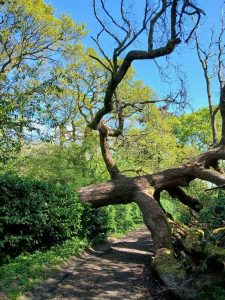
The UK’s ancient woodland indicator species (wood anemone, bluebell, wild garlic) are extremely slow colonisers and may never return to a plantation site naturally.
- In 2-5 years, if the soil has not been too heavily
- disrupted, a cleared or felled commercial conifer plantation will begin colonising with birch, willow, and pioneer species.
- It takes 100-200 years for a native broadleaved woodland with structural complexity (standing deadwood, diverse understorey, multi-age canopy) to develop without human intervention.
- An ancient woodland with unique soil fungi, invertebrate communities, and plant species, is effectively irreplaceable on any human timescale.
Conclusion
The sobering truth is that nature does not work to a human timeframe. The myriad natural wonders that form our landscape with all their miraculous complexity and diversity have evolved over millennia. Put into human units of years and decades, a lifetime of four score years and ten, we will not live to see nature heal the damage we do and replace the habitats we are destroying. And in some habitats, neither will our great-great-grandchildren.