


Houses with Literary Connections 5: Jane Austen and Chawton, Hampshire
Jane Austen 1775-1817
In a newsletter edition which focuses on data and 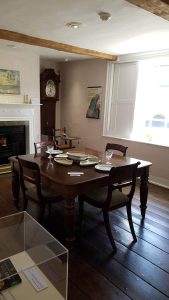 technology, it seems ironic that this month’s literary focus is Jane Austen, but there is a connection. She would have smiled, wryly, at today’s term ‘Internet of Things’, as defined by Cisco Systems as “simply the point in time when more ‘things or objects’ were connected to the Internet than people”, and wittily adapted her writing to explore both relationships in society and with those ‘things or objects’. The connection? Two American Electronics millionaires from Cisco Systems admired Austen’s work. Their philanthropy transformed Jane Austen’s brother’s lovely but tired Chawton manor house into a fabulous centre for, guess what? The study of early female writers.
Jane Austen placed her writing table strategically. 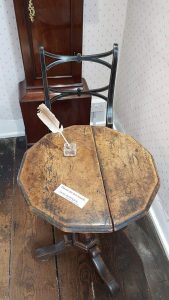 Like pupils in school, switching tabs when teacher walks round the classroom, at the merest glimpse of a visitor approaching Chawton Cottage, she would blot, then shuffle her manuscript pages together – possibly cursing – and conceal them before the intruder could reach the door. She never did publish a book under her own name in her lifetime, simply stating ‘by a Lady’ or, ‘by the author of…’.
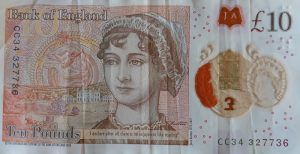
But, dear reader, unless you live under a stone, you will already know all about Jane Austen. Jane is everywhere. Even our bank notes. Huzzah! She warrants it. Her brilliant novels, and brilliant spin-offs from her novels, have all been dramatised to the nth degree and Colin Firth’s soggy shirt (there were apparently three of them made, by the way), has done its own bit to immortalise her. This is not the place for lit crit, so there is a plain list of her novels at the end (which does not include her letters, juvenilia, plays and unfinished works etc). For more information, hit Professor Google and slide down the rabbit hole in some remote data centre to endless – and fascinating – information. This is Jane Austen-Lite. And there’s a weak pun in there for the cognoscenti.
Back to Chawton village. By the time Jane moved there in 1809, she was in her 30s and the ‘best bit’ of her life was over. Her father, George, had provided a comfortable and stimulating home for his wife and eight children on a limited income as Vicar of Steventon, Hampshire. Jane had unfettered access to his library and that of his friend, Warren Hastings, later Governor of India. She wrote copiously from an early age, entertaining her lively and loving family with evening readings, although by 1809 nothing had been published, despite various attempts.
When Rev George had abruptly decided to retire to Bath in 1801, Jane had been stunned. Steventon had been her only home. It was the anchor for her travels between periods at school, visits to numerous relatives and life growing up in a happy, intelligent and close-knit family.
Then George died in 1805 and Jane, her widowed mother, spinster sister Cassandra plus a friend, Martha Lloyd, needed somewhere cheaper to live. After four years’ renting in Bath, then Southampton, 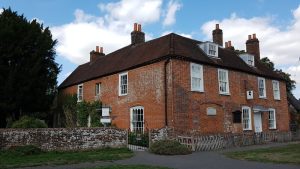 Jane’s wealthy landowner brother, Edward Austen-Knight, stepped in. He had been adopted as a child by wealthy but childless Austen relatives, and, having inherited at their deaths, was able to offer them use of a cottage attached to his Chawton estate (as opposed his other estate at Godmersham in Kent…).
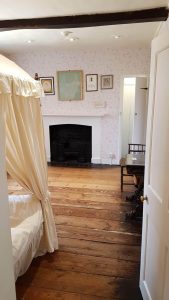 It was at Chawton that Jane seems to have started writing again after rather fallow years since Steventon. She revised drafts of her earlier novels and started new ones. In 1810, ‘Sense and Sensibility’ was accepted for publication. Others followed; finally, she knew success – and that the admiring Prince Regent had copies of her novels in all his residences.
Tragically, she died, aged 41, in 1817, before ‘Persuasion’ or ‘Northanger Abbey’ were published or she could finish ‘Sanditon’ and ‘Lady Susan’. She was buried in Winchester Cathedral.
Just in case a reader is not aware and cannot be bothered to Google, although Jane Austen may have lived very quietly, there was less than one degree of separation from some very dramatic (world) events. She made a conscious decision not to focus her writing on them. These events include:
- The French Revolution: her sister-in-law was the widow of a guillotined French noble. Jane heard ALL about his execution.
- The Napoleonic War: constant fear of invasion.
- The Napoleonic War 2: two brothers were Admirals and one a soldier, so she was fully cognisant of its course.
- Slavery: brother Frank travelled to the East Indies in the Navy – treatment of enslaved people can scarcely have escaped his notice or domestic comment. During her lifetime, British public opinion shifted vocally towards the abolition of slavery.
- Legal Wrangling: scandalously, an aunt was tried for shop lifting, which hit the press.
- Legal Wrangling 2: where there’s a will, there’s a relative. Any relative with money was regarded as fair game in the struggle to afford life in polite society and the Austens were no exception.
- Adoption: Jane’s eldest brother Edward, see above.
- Disability: Jane’s brother George had developmental issues and lived in paid care away from the family.
- Romance: we know from the TV series (!) that Cassandra’s fiancé died while travelling abroad, but we only know a few facts about Jane’s love life because Cassandra destroyed the juiciest years’ worth’s of her letters. Either there were some real romances or Cassandra sought to spare feelings: Jane’s unfiltered wit might posthumously have hurt or offended.
Jane Austen’s (completed and adult) Novels
In order of publication
‘Sense and Sensibility’
‘Pride and Prejudice’
‘Mansfield Park’
‘Emma’
‘Northanger Abbey’
‘Persuasion’