

National Trust Houses with Literary Connections 4:
Rudyard Kipling and Bateman’s, Burwash, East Sussex.
He wrote the nation’s 1995 favourite poem, ‘If’. His novel ‘The Jungle Book’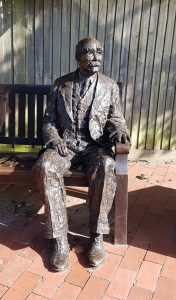 provided the plot of one of Disney’s most loved films. He was the Victorian child sent from India aged five with his three-year-old sister to a (traumatising) Portsmouth boarding house to facilitate schooling in the Old Country. He was the student not considered clever enough to secure a scholarship to Oxford who went on to be the youngest ever winner of the Nobel Prize for Literature. His unusual known-as name came from the Staffordshire lake where his parents courted and, today, if he is known at all, it is for ‘The Jungle Book’ and ‘If’. He was a product of the British Empire and an establishment figure but with the imagination and heart and intelligence to explore worlds outside them in his writing. The jury is out on his reputation in the post-colonial post-mortem that inevitably follows British creatives with a colonial background. But, as he says in ‘If’, you have to ‘meet with triumph and disaster/And treat those two impostors just the same’.
Bateman’s
Bateman’s is a charming, Grade 1 listed Jacobean house.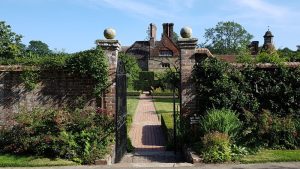
It was given to the National Trust in 1940 after the Kiplings’ surviving child, Elsie, died. The beautiful – and comfortable – house is maintained as a museum to Rudyard Kipling and contains items he collected and lived with: Jacobean furniture to complement the house; oriental lacquered items; pieces by his artist father and items from his travels and time in India. Kipling wrote of Batemans ‘We have loved it ever since our first sight of it… We entered and felt her Spirit – her Feng Shui – to be good.’
The entrance porch in the east face has a round-headed archway 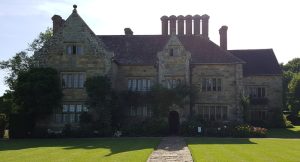 with pilasters and a scroll pediment carved with the date 1634, but it is probable that there was property there long before that. Kipling and his family found items dating back to Neolithic times when they developed the garden.
Built in mellow local sandstone, with a tiled roof, the house has two storeys and an attic in the gables. The east-facing entrance was originally E-shaped (as traditional with earlier, Elizabethan buildings), but the projecting north wing no longer exists. The central projection provides a porch with two storeys above, surmounted by kneelers and a ball finial. The many casement windows have stone mullions, transoms and drip stones over, creating a harmonious repetition.
On the roof is an ‘impressive row of six diamond-shaped red brick chimney stacks’.
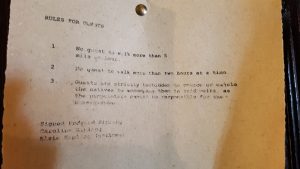
The interior is full of original features including a fine staircase, stone fireplaces, oak beams and panelled walls. Kipling’s study is kept as he left it, and there are little notices left about the house for family guests which give the feeling that at any point a member of the family will walk into the room.
The Grounds
The purchase initially included grounds of 33 acres. Kipling’s surviving daughter Elsie commented that they wanted the house and its surroundings to fit “like a lovely cup on a matching saucer.” To that end, he designed and planted a rose garden with a lily pool, laid out a walled kitchen garden with a mulberry tree in it, and gradually extended the grounds to over 300 acres, including an old quarry, woodlands, a river and a mill. Not only did the Kipling family make the most of their corner of Sussex, but it also inspired the poet and author to write ‘Puck of Pooks Hill’ and other pieces exploring history and the landscape. The evocative poem ‘The Way Through the Woods’ was also a product of this happy time.
Kipling ‘Nuggets’ 
Kipling’s ‘The Jungle Book’ provided the Scouting movement with its junior term: ‘Wolf Cubs’ as the protagonist, Mowgli, was raised alongside wolf cubs.
Kipling joined the War Graves Commission after WW1.
Kipling suggested the phase ‘Known Unto God’ for graves of unidentified war dead.
Kipling chose the phrase ‘The Glorious Dead’ for Lutyens’ Cenotaph in Whitehall.
Kipling scripted the first Royal Christmas Message for George V in 1932.
Kipling was Lord Rector of the University of St Andrews from 1922-25.
Kipling’s poetry was popular in Russia, despite being considered ‘fascist’!
Kipling rejected a knighthood and the post of Poet Laureate, according to a biography by Lord Birkenhead.
Kipling was asked to write a specialised graduation ceremony for Engineering students at the University of Toronto because of his poems exploring aspects of ‘Craft and Industry’ and war poems like ‘Sappers’. His ‘The Ritual of the Calling of an Engineer’ led to all Engineering graduates in Canada being presented with an iron ring as an emblem of their responsibility to society.
Kipling, an accomplished artist, illustrated many of his own tales,
Kipling’s ashes are interred next to those of Charles Dickens and Thomas Hardy in Westminster Abbey.
Rudyard Kipling (1865 – 1936) Selective Biography
Rudyard Kipling was born in Bombay, now Mumbai. His father was the Principal and Professor of Architectural Sculpture at the Sir J. J. School of Art there. Through his mother, Kipling’s uncles were the artists Edward Burne-Jones and Edward Poynter and the future Prime Minister Stanley Baldwin.
Indian Legacy
Kipling’s psyche was rooted in his Indian infancy and, when he finally returned to Bombay aged 16, he found himself instinctively speaking sentences in a language he no longer understood. The next six years he spent as a workaholic journalist, happy and fulfilled, and his love of India and its culture’s formative influences on him are integral to him and to his writing.
That writing flowed from him. A colleague recalled ‘”In the hot weather when he (Kipling) wore only white trousers and a thin vest, he is said to have resembled a Dalmatian dog more than a human being, for he was spotted all over with ink in every direction.”
As to form, journalism paid Kipling’s wages initially, but poems, short stories and novels poured out. His poems may seem traditional in use of meter and rhyme, but he experimented with narrative forms and even ‘speculative fiction’ (what would now be termed ‘science fiction’). These have influenced writers as varied as Robert Heinlein and the Russian poet Konstantin Simonov.
England and America
In 1889, Kipling moved to London, buoyed up with money from publishing collections of his stories. He travelled extensively en route, including to Japan. In 1892 he married Caroline Balestier, sister of his American friend and publisher Charles. They honeymooned in America and, when their bank failed, they stayed there, living in New England until 1896. Now with two daughters, they moved to Torquay in Devon, where their son John was born and where memories of his (happier) Devon schooldays in Westward Ho! inspired the novel ‘Stalky and Co’.
Hugely successful, Kipling kept writing and was invited to travel widely. Experience in South Africa, amongst other places, inspired further poetry.
Bateman’s, Burwash, East Sussex
In 1897 the Kiplings moved to Rottingdean in Sussex and in 1902 they found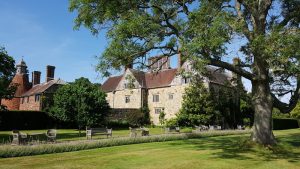 Bateman’s. Sadly, they had lost their first daughter, Josephine, to pneumonia. The charming house – and the garden the Kiplings designed to provide a fit setting for it – provided balm and inspiration in equal measure.
In 1907 Kipling was the first writer in English to receive the recently-created Nobel Prize for Literature. His prize citation said it was “in consideration of the power of observation, originality of imagination, virility of ideas and remarkable talent for narration which characterize the creations of this world-famous author.”
‘My Boy Jack’
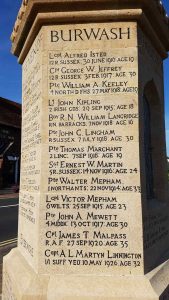
Kipling’s son John was rejected for the Navy and the Army in WW1, but the 1997 play ‘My Boy Jack’ explores Kipling’s role in using his contacts to get John accepted into the Army. John went ‘missing in action’ in September 1915. Although his death was later confirmed, a tormented Rudyard and desperate Caroline travelled all over Northern France after the war, convinced they would find him, marking off everywhere they had visited on a map you can see at Bateman’s today. Kipling wrote a poem, ‘My Boy Jack’, about Jack Cornwell, at 16 the youngest recipient of the Victoria Cross, exploring themes of sacrifice, duty and parental loss. Kipling’s son John was never nicknamed Jack but the grief is clearly an experienced emotion.
In the years following WW1, Kipling continued to write prolifically and remained a bastion of Englishness and Empire – although, read carefully, his words are not always uncritical. He was deeply concerned about the rise to power of Germany and warned against future conflict right up to his death in 1936.