

The World’s Largest BESS Installations. The Race is ON!
BESS can be judged against either megawatts (MW) or megawatt hours (MWh). The latter is what matters for grid services.
California
Until early 2024, the record was held by Vistra’s Moss Landing Energy Storage Facility in Monterey County, California, which reached 750MW and 3,000MWh of capacity. Moss Landing became both a symbol of the BESS revolution and one of its cautionary tales: in early 2025, a serious thermal runaway fire damaged significant portions of the facility, underscoring that battery safety at scale remains a genuine challenge.
By January 2024, Moss Landing had been surpassed by the Edwards & Sanborn Solar and Energy Storage facility in the Mojave Desert, Kern County, California. Built by Mortenson for developer Terra-Gen on land partly leased from Edwards Air Force Base, the project spans approximately 1,886 hectares and pairs 875 megawatts of solar generation with 3,287MWh of battery storage. Incorporating 1.9 million solar panels and over 120,000 battery modules from LG Chem, Samsung, and BYD, it held the operational record through 2024 and into 2025.
Saudi Arabia
By late 2025, Saudi Arabia had joined the race. In December 2025, Chinese manufacturer Sungrow connected a 7.8GWh BESS project across three locations to the Saudi electricity grid. Almost simultaneously, Saudi Electricity Company signed a contract with China’s BYD to build a 12.5GWh system across multiple sites, the largest single grid-scale storage procurement ever made. Saudi Arabia is targeting 48GWh of installed BESS capacity by 2030, This is driven by the need to harness colossal solar resources to power industrial loads and AI data centres around the clock.
China
In December 2025 alone, China installed more BESS capacity than the US did in the entire year. Chinese manufacturers now account for seven of the top ten global BESS integrators. Australia, Chile, and the Netherlands are also deploying major projects, with Chile’s 3.5GWh Elena BESS — part of the Oasis de Atacama complex — coming online in June 2026.
BESS in the United Kingdom
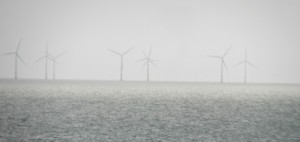
The UK has emerged as one of Europe’s most active BESS markets, driven by its high proportion of offshore wind generation, an electricity market structure that rewards grid-balancing services, and the need to reduce the £3.5 billion worth of renewable energy wasted annually through curtailment.
Since 2020, the UK’s operational battery storage capacity has grown by more than 500%, rising from approximately 1,100MW to nearly 7GW by 2025.
The government has set a target of reaching up to 27GW by 2030. Planning permission was granted for 28.6GW of battery storage projects in Great Britain in the first three quarters of 2025 alone — up 92% on all of 2024.
The Teesside GigaPark, announced by NatPower UK in August 2025, is one of the biggest planned so far. Planned for a 13-hectare (32-acre) site at Wilton International in Redcar, North Yorkshire, the £1 billion privately-funded project will deliver 1GW of power with up to 8GWh of storage capacity, operating initially at 4GWh before doubling. The project holds a 1GW connection agreement with the National Energy System Operator and aims to be operational by 2028.
In Scotland,
- Coalburn 1, South Lanarkshire was developed by Copenhagen Infrastructure Partners and Alcemi on the site of a former open-cast coal mine and covers 15.8 hectares, delivering 500MW and 1,000MWh of storage.
- Coalburn 2, occupies approximately 22 hectares on the same site and adds a further 500MW and 2,000MWh, with commissioning targeted for August 2027. The two phases combined represent one of Europe’s largest BESS developments.
- Fithie Energy Park near Dundee is a proposed 1,400MW BESS development planned on approximately 39 hectares (97 acres) of agricultural land at Tealing in Angus. A planning application has been submitted to the Scottish Government’s Energy Consents Unit, with the project designed to serve up to 1.6 million homes at peak demand.
Currently
Dozens of smaller-scale BESS proposals are moving through the UK planning system, from Hertfordshire farmland to former industrial sites across the Midlands and North to North Devon’s rolling countryside.
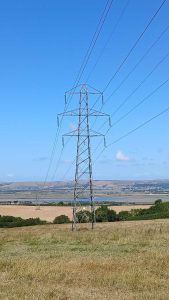
However, there is resistance at local level. Quite apart from fears about safety and the risk of thermal runaway in lithium-ion batteries (which can cause complex fires), there is concern about noise and the industrialisation of shrinking green spaces. Britain is a tiny country compared to the vastness of the US, Australia or China where massive BESS facilities may be more easily absorbed.
Local councils have often rejected proposals only to be overridden by the government. Scotland’s Energy Consents Unit has approved every standalone BESS application it has received.
Conclusion
There is a way to go with infrastructure and ever-developing technology, but in under 10 years, BESS has evolved from niche tech to a cornerstone of the global energy system.
The UK, with its exceptional offshore wind resource and urgent need for grid flexibility, is well placed to benefit from it – but who will profit and will the cost to the landscape be worth it?