

National Trust Literary Connections 2: Lamb House, Rye, and Henry James (EF Benson, Rumer Godden, Joan Aiken…)
Rye in East Sussex has been big in social media circles recently as the film location for the latest remake of ‘Pride and Prejudice’. It also provided the setting for the 2014 series ‘Mapp and Lucia’. Its charming streets of ancient and delightful buildings well deserve the attention, and although Jane Austen never visited, a number of other literary figures certainly did, and many of them lived in, visited, or were inspired by National Trust property, Lamb House.
Lamb House
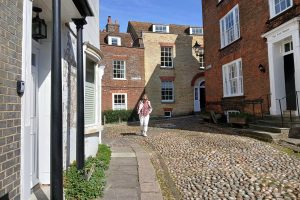
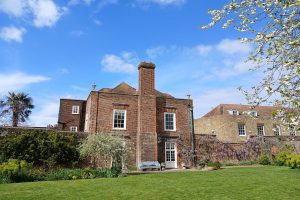
Rising rather surprisingly from where the narrowish cobbled lane in the centre of Rye widens out on a bend, Lamb House is an elegant Georgian red brick building with large sash windows and three steps up to a graceful front door. The wall that curves graciously round a beautiful garden that became Henry James’s joy and retreat and was designed by his friend Alfred Parsons.
Lamb House was built in 1722-3 for James Lamb, wine merchant and local politician. When George 1’s ship came aground at Camber Sands in 1726, this was the house the locals considered most appropriate to take him. What is now known as the King’s Room was Lamb’s own bedroom, given up to the exhausted monarch who later became godfather to Lamb’s son. Historic oak panelling survives in that room and in the Oak Parlour and the whole gracious house is distinguished without being grandiose: the kind of place you can imagine living happily.
In 1743 an extension, ‘The Garden Room’, was added to the house. Intended as a dining area, this became a favourite spot for James to write. Sadly, it was hit by a bomb in WW2 and nothing of it remains.
Henry James
Two and a half centuries later, Henry James was licking his wounds after the failure of his play ‘Guy Domville’, in London in 1895. He went and hid with a friend in Rye where he fell in love with Lamb House. He rented it then two years later, bought it outright. He wrote his psychological ghost/horror novella ‘The Turn of the Screw’ in his London apartment while Lamb House was being refurbished, but it was in his new home that he wrote some of his most famous novels, including ‘The Wings of the Dove’, ‘The Ambassadors’ and ‘The Golden Bowl’, earning the nickname of ‘The Master’.
While James was living in Rye, a tribe of literary greats visited Lamb House including H.G. Wells, Rudyard Kipling, Ford Madox Ford, Max Beerbohm, and Edith Wharton. Despite her reservations about his writing, Virginia Woolf was another visitor. Touchingly, James was a very generous host but is recorded as mourning over left-overs from meals, as money was always a worry.
‘The Master’
An American, born in 1843, Henry James grew up in an intellectual household in Manhattan, in New York. His brother William became a psychologist and a profound interest in the conflict between motivation and action and consequences also drives James’s writing. His wealthy family travelled frequently to Europe, James was fluent in French and settled in Europe during his thirties, enabling him to explore the impact of European culture and society on his protagonists. He became a British Citizen in 1915 after a lifetime writing plays, literary criticism, biography, autobiography and journalistic articles.
Influenced hugely by his reading of French and English realism rather than his unorthodox education, Henry James is admired for the subtlety of his prose and his focus on the internal life of his characters. Somerset Maugham commented that “The great novelists, even in seclusion, have lived life passionately. Henry James was content to observe it from a window…” but continued, “The fact remains that those last novels of his, notwithstanding their unreality, make all other novels, except the very best, unreadable.”
James was nominated for the Nobel Prize for Literature in 1911, 1912 and 1916. His sentences may be long, and British writers struggled with his multi-layered delicacy, but his understanding of inner realities nonetheless provided a spring-board for 20th century writers like Virginia Woolf and TS Eliot, paving the way for the stream-of-consciousness style and convincing psychology we expect today.
Later Literary Connections
A number of distinguished writers and publishers have lived at Lamb House, which was given to the National Trust in 1950.
EF Benson
Henry James’s friend EF Benson moved into Lamb House in 1919, becoming Mayor of Rye from 1934-7. A prolific writer, he is best known now for his ‘Mapp and Lucia’ novels, set in a fictional version of Rye called ‘Tilling’. Lamb House and Rye provided the film location for the 2014 television adaptation, bringing the connection pleasingly full circle.
H Montgomery-Hyde
An early human rights campaigner, author, biographer, barrister and politician, H Montgomery Hyde lived at Lamb House from 1963-67. He was also a second cousin of Henry James.
Rumer Godden
Author of over 60 novels and non-fiction books, Rumer Godden is best known for the Oscar-winning ‘Black Narcissus’, starring Deborah Kerr. She also won the first Whitbread Children’s Book Award for ‘The Diddakoi’ in 1972. Godden lived at Lamb House from 1967-74 and is buried in Rye church yard.
Sir Brian Cook-Batsford
Chairman of Batsford Publishing, Sir Brian was a painter, designer, publisher and Conservative Politician. He lived at Lamb House from 1980-87.
Joan Aiken MBE
Although neither an owner nor a tenant, author Joan Aiken was born in Rye. Famous for her children’s books like ‘The Wolves of Willoughby Chase’ and ‘Black Hearts in Battersea’, she wrote ‘The Haunting of Lamb House’ inspired by the house and by James’s and Benson’s interest in ghosts.
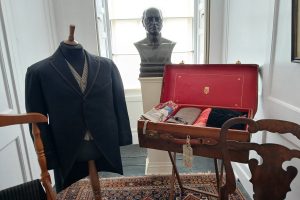
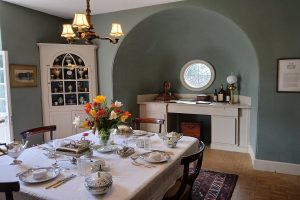
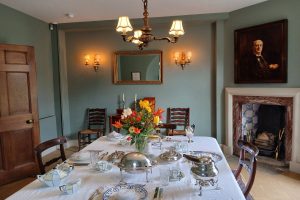
Below are some more photos of Lamb House.
Whether seeking a quiet place to read, or inspiration to write, a visit to Lamb House may be just what you need.