

What Price Diamonds?
Or, be careful what you wish for…
High-minded romantics are eschewing traditionally-mined diamonds for their gifts and, instead, are selecting lab produced stones. It helps that they are 40-80% cheaper than mined ones and it is not surprising that lab-grown diamonds currently make up 10% of the market.
Jewellers confirm that it is impossible to tell the difference between a stone that has been created in a laboratory and one that has been dug out of the earth with human sweat and toil.
Films like ‘Blood Diamond’ have raised public awareness of the corruption and brutality that can lie behind the hard beauty of earth’s most precious stone. The film, carefully researched, tells the story of a local man, torn from his family by a powerful overlord, who is made to mine the diamonds that finance his military campaign in brutally war-torn Sierra Leone. The proverb that power corrupts is illustrated at all levels, and diamonds, the currency of that corruption, have become tainted.
So, people are buying fewer diamonds and when they are, cheap lab-grown ones are increasingly popular.
BUT
The unintended consequence of this is that Botswana’s economy is in free fall and the reason is simple: people are not buying their diamonds.
Not all diamonds are born of conflict and oppression. Botswana in sub-Saharan Africa, has had an enviable political stability and its people have enjoyed a quality of life envied across the continent through prudent investment enabled by their principal export: diamonds.
Recipe for a Lab Grown Diamond
Ingredients:
Tiny piece of diamond
Catalyst metal (iron or nickel or cobalt)
Powdered graphite
Method:
Stack your diamond seed, powdered graphite and powdered catalyst metal in a special casing.
Place these in a special machine.
Subject the casing to over 2000 degrees in temperature and, simultaneously, over 800 000 lbs of pressure per square inch.
Leave for several days (or weeks if you want a bigger product) to allow the metal and graphite to form carbon bonds around your diamond seed.
Allow to cool slowly.
Remove and use lasers to cut the diamond, then polish with specialist wheels coated with increasingly fine diamond dust to create the facets and smooth surface that will perfectly refract light.
Etch a microscopic serial number into your stone to confirm origin and human manufacture.
Et voila! A new diamond, chemically identical to a mined one.
So, back to Botswana.
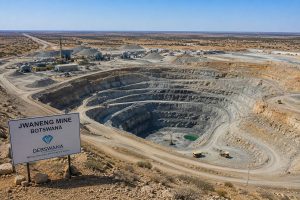
A former British Colony, Botswana became one of the richest countries in sub-Saharan Africa through its natural resource: diamonds. Prudent management of the income from diamonds has ensured investment in education and health care and development of infrastructure. Even in remote areas, public investment ensured creation of clean water sources. This led Botswana to surpass South Africa in per capita income, providing a high quality of life of which those in war-torn areas could only dream.
Diamonds have been at the core of Botswana’s economic stability, but the global slump in the market for diamonds is having a disastrous impact. According to the International Monetary Fund, unemployment is rising and the coffers are running dry, with little opportunity for diversification. This problem with diversification is aggravated as businesses are struggling to access finance with which to invest and diversify. In addition, there is increasing concern about corruption, an issue on which Botswana previously had a ‘stellar’ reputation.
So, what price diamonds? The L’Oreal adverts tell us we deserve diamonds if we want one ‘Because you’re worth it’. Tesco’s justifies frugality telling us ‘Every Little Helps’, and we feel better about buying cheap diamonds because no person was harmed in their creation. For now, we will ignore the staggering amount of natural resources required to create a lab diamond…
The unintended consequence is that the true cost of progress is the lives of the people in Botswana.